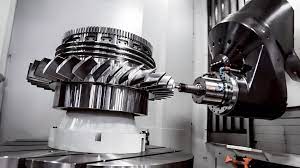
History of CNC machining
PARIS, France — From paper punch cards in post-war aviation labs to multi-axis automated hubs powering global aerospace, Computer Numerical Control (CNC) machining has evolved into a cornerstone of modern industrial manufacturing. Valued at tens of billions of dollars worldwide and projected to clear $100 billion as smart manufacturing accelerates, automated subtractive manufacturing allows factories to transform digital CAD models into micro-precision components without direct human intervention. Driven by advances in computer-aided design (CAD), computer-aided manufacturing (CAM), and Industrial Internet of Things (IIoT) platforms, CNC tools now define the boundaries of mass production across sectors ranging from biomedical devices to defense.
Core Operational Principles and Process Workflow
Unlike additive manufacturing techniques like 3D printing, CNC machining uses subtractive processes—removing material from a solid workpiece using high-speed rotary tools or electrical discharges until the exact specifications are met.
The standardized industrial workflow follows four critical stages:
-
- CAD Model Generation: Designing 2D vector or 3D solid models using specialized software, subsequently exported into universally compatible formats like STEP or IGES.
-
- File Conversion to Machine Code: Processing the spatial design through CAM software to extract component geometry and generate G-code instructions that govern feed rates, spindle speed, and tool paths.
-
- Machine Calibration: Securing raw materials (billets) into workholders, vices, or chucks, while installing specific tooling bits such as end mills, drills, or taps.
-
- Program Execution: Running the computerized code to guide multi-axis toolheads through cutting, turning, or drilling operations with micrometer-level precision.
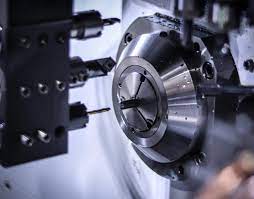
Primary Machining Operations & Material Compatibility
| Machining Operation | Mechanism | Primary Applications | Material Options |
| CNC Milling | Moves rotating cutting tools against stationary workpieces across multiple axes | Face milling, deep cavities, complex structural enclosures | Metals: Aluminum, Stainless Steel, Brass, Tool Steel |
| CNC Turning | Rotates the workpiece while single-point tools cut along the linear axis | Cylindrical shapes, internal boring, custom threading | Plastics: ABS, Nylon (PA), PEEK, Delrin (POM), PTFE |
| CNC Drilling | Advances rotating bits vertically into stationary workpieces | Precision holes, counterboring, tapping | Composites: Carbon Fiber, Reinforced Fiberglass |
| Electrical Discharge (EDM) | Uses electrical spark discharges between electrodes to erode metal | Intricate molds, hardened alloys, high-risk components | Hardened conductive metals and aerospace alloys |
What does this decision/news mean for the citizen/follower?
For consumers and daily tech users, the ubiquity of CNC machining directly underpins the durability, miniaturization, and accessibility of everyday devices. Modern unibody aluminum laptops—pioneered by Apple’s single-block CNC milling techniques—as well as high-density circuit boards inside smartphones owe their structural integrity and compact form factor to computer-guided machining.
For the average citizen, advancements in CNC production reduce end-user costs for critical goods, improve automotive safety standards through precision-milled braking components, and enable life-saving medical innovations. Custom orthopedic prosthetics, titanium joint implants, and non-invasive surgical robotics are all made economically viable through automated, low-volume CNC runs.
Historical Evolution: From Punch Cards to Smart Factories
The roots of computerized manufacturing trace back to the late 1940s, when John T. Parsons partnered with MIT’s Servomechanisms Laboratory to fabricate complex helicopter rotor blade templates using paper punch cards. By 1952, Parsons and MIT demonstrated the first experimental continuous-path numerical control (NC) milling machine, establishing the baseline for automated toolpaths.
Subsequent milestones fundamentally altered the economic landscape of production:
- The APT Language (1950s): Lead researcher Douglas T. Ross developed the Automatically Programmed Tool (APT) language, creating a standardized programming framework that became the global standard by 1978.
- PRONTO & Direct Numerical Control (1957–1960s): Dr. Patrick Hanratty introduced PRONTO, launching CAM software, while Direct Numerical Control (DNC) eliminated paper tapes by feeding files straight from computers to tool controllers.
- PC Democratization & 3D Integration (1970s–1980s): The advent of low-cost minicomputers, Unix workstations, and 3D CAD/CAM in 1976 enabled real-time multi-tasking across multi-axis lathes and milling centers.
Looking Ahead
As industrial hubs across the Asia-Pacific, Europe, and North America adopt Industry 4.0 frameworks, CNC machining is converging with machine learning and automated robotics. Software platforms like FANUC’s FIELD now connect CNC tools directly to cloud networks, providing predictive maintenance alerts and real-time operational diagnostics to eliminate factory downtime. Moving forward, the fusion of sustainable manufacturing—focused on lower carbon footprints and minimal material waste—with multi-axis hybrid CNC systems will ensure that computerized machining remains the central engine of global hardware innovation.